
Introduction
Energy Performance Certificates (EPCs) play a major role in UK commercial property compliance, influencing leasing, investment, and sustainability decisions.
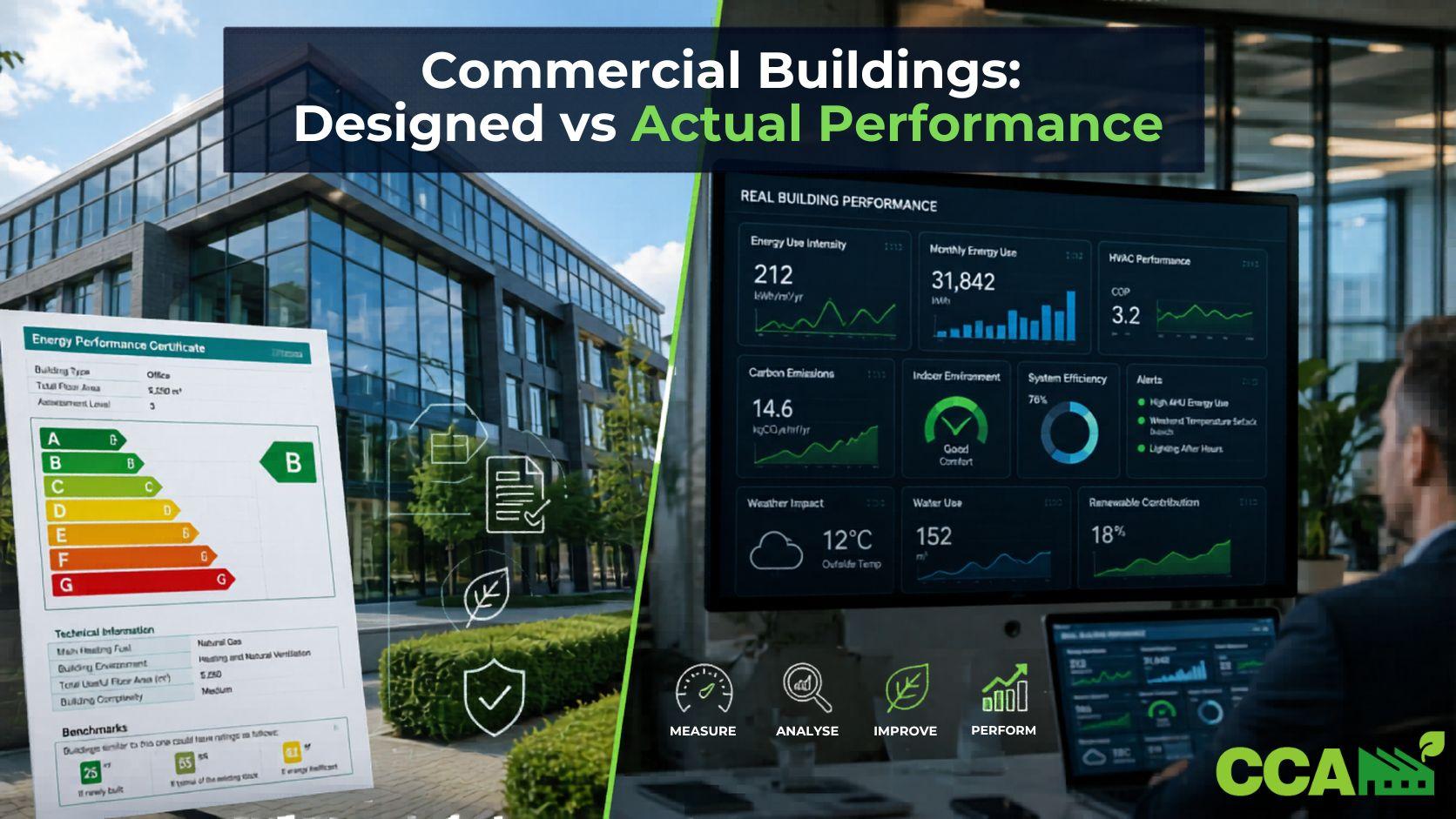
However, a compliant EPC rating does not always reflect how efficiently a building performs once occupied. Many commercial buildings with strong EPC ratings still experience high operational energy usage, rising utility costs, and inefficient system performance in day-to-day operation.
As energy costs rise and ESG expectations continue to evolve, businesses are placing greater focus on real operational building performance rather than theoretical efficiency ratings alone.
This article explores why standard EPCs often fail to reflect actual commercial building performance and why deeper operational analysis is becoming increasingly important across the UK property sector.
What a Standard EPC Is Actually Designed to Measure
One of the most common misunderstandings surrounding commercial EPCs is the assumption that they reflect how efficiently a building operates in real life.
In reality, a standard EPC is an asset rating. It measures the theoretical energy efficiency of a building based on standardised modelling assumptions rather than actual operational usage.
The assessment typically evaluates factors such as:
- building fabric and insulation
- lighting systems
- heating and cooling infrastructure
- ventilation systems
- glazing performance
- construction materials
Using approved methodologies such as SBEM calculations, the building receives a rating between A and G.
While this provides a useful benchmark for compliance purposes, the calculation does not continuously monitor how the building operates once occupied.
For example, a standard EPC does not fully account for:
- tenant behaviour
- occupancy fluctuations
- operational schedules
- maintenance standards
- after-hours equipment usage
- changing space utilisation
This distinction is critical because commercial buildings rarely operate exactly as originally modelled.
As a result, the theoretical performance reflected within an EPC can differ substantially from the building’s actual energy consumption over time.
The Commercial Property Sector’s Growing Performance Gap
Across the UK, increasing attention is being placed on what is commonly referred to as the “performance gap”.
This describes the difference between a building’s predicted energy performance during design and assessment stages, and its actual operational performance once occupied.
In many cases, commercial properties consume significantly more energy than their EPC modelling originally suggested.
This issue has become particularly important in modern commercial buildings where sustainability targets are often ambitious during development stages, yet operational results fail to align with expectations.
Part of the problem is that commercial buildings are dynamic environments. Occupancy patterns evolve, technology changes rapidly, operational demands increase, and building systems are frequently adjusted over time.
Even relatively minor operational inefficiencies can gradually create substantial increases in energy consumption.
For property owners, investors, and facilities managers, this creates an important challenge. A compliant EPC rating may no longer provide sufficient insight into how efficiently a building actually performs in practice.
This growing focus on operational performance has also increased interest in more advanced building analysis approaches, particularly those explored in Why TM54 Energy Assessments Matter for Commercial Buildings.
Why Buildings Rarely Perform Exactly as Modelled
Commercial buildings are influenced by countless operational variables that standard EPC calculations cannot fully predict.
A building designed around standard weekday office occupancy may later accommodate hybrid working patterns, extended operating hours, increased server loads, or entirely different tenant requirements.
Over time, these operational changes can dramatically alter energy usage.
Consider a multi-tenant office building originally assessed under relatively straightforward occupancy assumptions. Once fully occupied, different tenants may implement entirely different working schedules, equipment demands, and environmental preferences.
One floor may operate traditional office hours while another functions almost continuously.
Meeting rooms may become permanently occupied. Cooling demands may increase due to additional IT infrastructure. Lighting systems may remain active outside business hours.
None of these operational realities are fully captured within a standard EPC calculation.
This is one reason why real-world energy performance can differ so significantly from predicted performance.
Building Systems Can Become Inefficient Over Time
Even buildings equipped with technically efficient systems can gradually become operationally inefficient.
This often happens slowly and without immediate visibility.
Controls may no longer reflect actual occupancy patterns. Heating and cooling systems may operate simultaneously in different parts of the building. Ventilation schedules may continue running long after spaces become unoccupied.
Maintenance practices also play a major role.
Poorly maintained HVAC systems, blocked filters, outdated controls, and calibration issues can all quietly increase operational energy consumption over time.
Cooling and ventilation inefficiencies are particularly common in larger commercial properties, especially where maintenance schedules and system controls are not regularly reviewed, an issue also highlighted in TM44 Air Conditioning Inspections UK: 2026 Requirements.
Importantly, a standard EPC does not continuously assess whether systems remain optimised years after installation.
It reflects a snapshot assessment based largely on theoretical assumptions.
As buildings evolve operationally, that snapshot can become increasingly disconnected from reality.
Why Operational Energy Performance Matters More in 2026
The commercial property sector is undergoing a wider shift in how building efficiency is evaluated.
Historically, compliance documentation often carried the greatest weight. Today, businesses are increasingly expected to demonstrate measurable operational performance improvements rather than relying solely on certification.
Several factors are accelerating this transition.
Rising Energy Costs Are Changing Priorities
For many organisations, energy expenditure has become a major operational concern.
Even relatively small inefficiencies can create substantial long-term costs across large commercial portfolios.
As a result, property owners are becoming far more focused on how buildings actually perform in day-to-day operation.
This reflects a wider shift across the commercial property sector, where operational performance and cost reduction are becoming increasingly connected, as explored in Why Energy Efficiency Is Now a Business Priority, Not an Option.
Businesses are no longer satisfied with theoretical efficiency claims alone. They increasingly want operational data that demonstrates where energy is being consumed and how inefficiencies can be reduced.
ESG Expectations Continue to Expand
Environmental performance is becoming a far more visible component of commercial property management.
Investors, occupiers, and stakeholders are paying closer attention to how buildings contribute towards wider sustainability goals.
As discussed in How ESG Regulations Are Impacting UK Businesses in 2026, organisations are increasingly expected to demonstrate measurable sustainability improvements rather than relying solely on theoretical compliance metrics.
This is particularly important for businesses with public sustainability commitments, net zero targets, or investor reporting obligations.
In this environment, operational building performance carries increasing commercial significance.
Investors Are Looking Beyond EPC Ratings
Commercial property investors are increasingly aware that a strong EPC rating does not automatically guarantee operational efficiency.
A building may appear compliant from a certification perspective while still carrying significant operational weaknesses beneath the surface. High energy consumption, ageing building systems, and inefficient operational management can all affect long-term asset performance, even where EPC ratings appear acceptable.
This has become particularly important as investors place greater emphasis on future resilience, sustainability exposure, and long-term operational costs during acquisition decisions.
Buildings that demonstrate efficient real-world performance are increasingly viewed as lower-risk assets. By contrast, properties with poor operational transparency may raise concerns around future upgrade costs, compliance liabilities, and occupier retention.
As operational performance becomes more closely linked to asset value, investors are paying closer attention to how buildings function in practice rather than relying solely on theoretical efficiency ratings.
Why Compliance Alone Is No Longer Enough
For many years, EPCs were treated primarily as a transactional requirement.
The focus was often limited to:
- obtaining minimum compliant ratings
- satisfying leasing obligations
- meeting property transaction requirements
- avoiding regulatory penalties
However, the commercial property sector is gradually moving beyond this compliance-only mindset.
A building may technically satisfy minimum standards while still operating inefficiently in practice. Excessive operational energy consumption, avoidable carbon emissions, and rising running costs can all exist despite a compliant EPC rating.
This is becoming increasingly important as commercial property regulations continue to evolve beyond basic certification requirements, particularly in areas covered within Commercial EPC Legal Requirements UK 2026.
The industry is increasingly recognising that theoretical asset ratings alone cannot provide a complete picture of long-term building performance.
Why More Detailed Building Analysis Is Becoming Essential
As expectations around sustainability and operational efficiency continue to evolve, businesses are seeking deeper insight into how buildings actually perform once occupied.
This has increased demand for more advanced analytical approaches that move beyond basic compliance reporting.
In many cases, organisations are no longer simply asking whether a building complies with regulations. Instead, they want to understand where inefficiencies exist, how systems are operating in practice, and what improvements may deliver measurable operational benefits.
For landlords and portfolio managers, deeper building analysis can support investment planning and long-term asset management decisions. For occupiers, it can help reduce operational costs and improve sustainability performance. Investors, meanwhile, increasingly value greater transparency around future building resilience and operational risk.
As operational performance expectations continue to rise across the UK commercial property sector, detailed building analysis is becoming less of a specialist exercise and more of a strategic necessity.
The Growing Importance of EPC Plus Reporting
Many organisations are now exploring more advanced reporting approaches such as EPC Plus Reports for MEES Compliance to gain a more detailed understanding of building performance and future regulatory exposure.
Enhanced reporting can help identify:
- operational inefficiencies
- future upgrade priorities
- compliance readiness
- opportunities for energy reduction
- longer-term building improvement strategies
Unlike standard EPC assessments alone, this broader level of analysis provides organisations with a clearer understanding of how buildings may perform over time under real operational conditions.
This is becoming increasingly valuable as commercial property owners attempt to future-proof assets against evolving environmental expectations and rising operational pressures.
Rather than viewing compliance as a one-time exercise, many businesses are beginning to treat building performance as an ongoing operational priority connected to both sustainability and long-term commercial resilience.
Operational Performance Is Likely to Shape Future Regulations
The UK’s long-term environmental strategy continues to place increasing emphasis on operational energy reduction.
Over the coming years, commercial property regulations are likely to focus more heavily on actual building performance rather than theoretical modelling assumptions alone.
Future expectations may increasingly involve:
- operational energy monitoring
- greater carbon transparency
- real-world efficiency reporting
- ongoing performance benchmarking
This reflects a wider shift across the industry towards measurable operational outcomes rather than compliance documentation alone.
As energy efficiency standards continue to evolve, organisations that proactively improve operational performance today are likely to be better positioned for future regulatory expectations, investor scrutiny, and long-term sustainability goals.
The Role of Professional Building Performance Assessments
Understanding how a building performs in real operational conditions often requires specialist expertise.
At CCA Environmental Ltd, building performance analysis is approached as part of a broader strategy focused on long-term efficiency, sustainability, compliance readiness, and operational optimisation.
Professional assessments can help organisations understand:
- where energy waste is occurring
- how systems are operating in practice
- which improvements offer the strongest value
- how future regulations may affect commercial portfolios
For larger or more complex commercial buildings, this level of insight is becoming increasingly important as operational performance expectations continue to rise.
Conclusion
Standard EPCs remain an important part of commercial property compliance across the UK. However, they do not always provide a complete reflection of how commercial buildings actually perform once occupied.
Real operational performance is influenced by a wide range of factors including occupancy behaviour, maintenance standards, operational schedules, system management, and changing building usage.
As energy costs rise and sustainability expectations continue to evolve, businesses are increasingly recognising the limitations of relying solely on theoretical building ratings.
For landlords, investors, developers, and facilities managers, deeper operational insight is becoming increasingly valuable for improving efficiency, reducing operational costs, and preparing for future environmental regulations.
The commercial property sector is gradually moving towards a more transparent and operationally focused approach to building performance.
Businesses that proactively understand and improve real-world energy performance are likely to be better positioned for long-term resilience and compliance.
Frequently Asked Questions
What does a standard commercial EPC measure?
A standard commercial EPC measures the theoretical energy efficiency of a building based on standardised assumptions relating to heating, lighting, ventilation, and building construction.
Why can buildings with strong EPC ratings still have high energy usage?
Actual operational performance can differ significantly from EPC modelling assumptions due to occupancy behaviour, operational schedules, maintenance issues, and inefficient system management.
What is the commercial building performance gap?
The performance gap refers to the difference between predicted building energy performance and actual operational energy consumption once a building is occupied.
Why is operational energy performance becoming more important?
Operational energy performance is becoming increasingly important due to rising energy costs, ESG expectations, investor scrutiny, and future environmental regulations.
How can enhanced reporting support commercial property owners?
Enhanced reporting approaches can help identify operational inefficiencies, future compliance risks, upgrade opportunities, and long-term energy improvement strategies.