
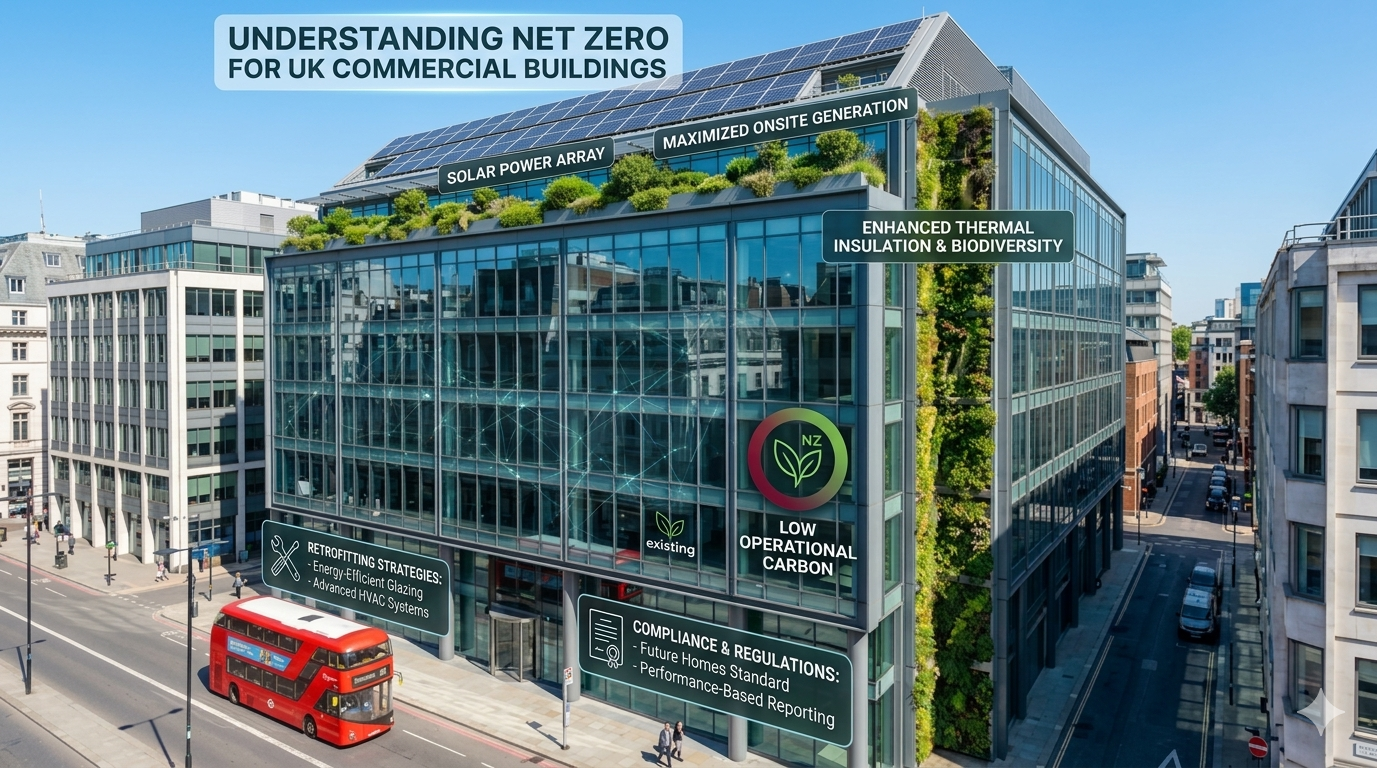
The term net zero has rapidly moved from environmental discussions into the centre of business strategy. For owners, developers and occupiers of commercial buildings across the UK, it is no longer a distant sustainability ambition but an urgent operational and regulatory priority. As the UK government pushes forward with its legally binding climate commitments, commercial property is facing significant pressure to reduce carbon emissions and transform how buildings are designed, operated and maintained.
But what exactly does net zero mean for UK commercial buildings? More importantly, how does it affect property owners, asset managers, tenants and developers? Understanding the concept and its practical implications is essential for anyone involved in the commercial real estate sector.
Understanding Net Zero in the UK Commercial Property Sector
At its core, net zero refers to achieving a balance between the greenhouse gas emissions produced and the emissions removed from the atmosphere. In simple terms, the amount of carbon emitted must be equal to the amount offset or eliminated.
For buildings, this primarily involves reducing operational and embodied carbon emissions as much as possible before using credible offsets to neutralize any remaining emissions. Operational carbon includes emissions generated from heating, cooling, lighting and running a building. Embodied carbon, on the other hand, refers to the emissions associated with materials, construction processes and the entire lifecycle of a building.
In the UK, the government has committed to reaching net zero carbon emissions by 2050. Since buildings account for roughly 40% of the country’s total carbon footprint when construction and operation are combined, the commercial property sector plays a critical role in achieving this target.
Why UK Commercial Buildings Must Move Towards Net Zero
Commercial buildings—offices, retail spaces, warehouses, hotels and mixed-use developments—consume significant energy and resources. Historically, many buildings were designed without energy efficiency or sustainability as a priority. As a result, older commercial properties often rely on outdated heating systems, poor insulation and inefficient lighting.
The shift towards net zero is being driven by several key factors:
Government regulation
The UK government is introducing stricter building performance requirements. The Minimum Energy Efficiency Standards (MEES), for example, already prohibit landlords from leasing commercial properties with poor energy performance ratings unless improvements are made.
Investor expectations
Environmental, Social and Governance (ESG) criteria are increasingly influencing investment decisions. Institutional investors now expect property portfolios to demonstrate credible decarbonization strategies.
Occupier demand
Businesses are under pressure to reduce their own carbon footprints. As a result, tenants are seeking office and commercial spaces that align with their sustainability commitments.
Rising energy costs
Energy efficiency is no longer just an environmental concern. Efficient buildings significantly reduce operational costs, making them more attractive to occupiers and investors alike.
Energy Efficiency: A Key Step Towards Net Zero Commercial Buildings
Improving energy efficiency is the most immediate and impactful step towards net zero commercial buildings. This involves reducing the energy required to operate the building while maintaining comfort and productivity for occupants.
Typical energy efficiency upgrades include:
- Installing LED lighting systems
- Upgrading insulation and glazing
- Implementing smart building management systems
- Replacing outdated boilers with low-carbon heating systems
- Improving ventilation and cooling systems
In modern developments, overheating analysis for new buildings is also becoming essential to ensure indoor comfort while maintaining energy efficiency.
Smart technology is also becoming increasingly important. Modern building management systems can monitor energy use in real time, allowing facilities managers to identify inefficiencies and optimize performance.
Energy efficiency improvements not only reduce carbon emissions but also increase property value and long-term asset resilience.
Renewable Energy and Electrification in Commercial Buildings
Another major shift in the transition to net zero is the move away from fossil fuels towards electrification and renewable energy sources.
Traditional commercial buildings often rely on gas boilers for heating. Net zero strategies increasingly involve replacing these systems with electric alternatives such as heat pumps. When powered by renewable electricity, these systems significantly reduce carbon emissions.
On-site renewable energy generation is also becoming more common. Solar photovoltaic panels installed on rooftops can generate electricity directly for building use, reducing reliance on the grid and lowering operational emissions.
In addition to on-site generation, many commercial property owners are entering power purchase agreements (PPAs) to secure renewable energy from external providers.
Reducing Embodied Carbon in Commercial Property
While operational energy often receives the most attention, embodied carbon is a growing concern in the construction industry. Every material used in a building—from steel and concrete to glass and insulation—carries a carbon footprint associated with its production and transport.
Reducing embodied carbon requires a shift in design and construction practices. Developers are increasingly exploring strategies such as:
- Reusing existing structures instead of demolishing them
- Choosing low-carbon construction materials
- Designing buildings for longer lifespans and adaptability
- Using modular or off-site construction techniques
Retrofitting existing buildings rather than constructing new ones is often the most sustainable option, as it preserves the carbon already embedded in the structure.
Retrofitting Commercial Buildings for Net Zero
Much of the UK’s commercial property stock was built decades ago, long before modern energy efficiency standards were introduced. As a result, retrofitting existing buildings is one of the most important steps in the net zero transition.
Retrofitting may involve simple upgrades, such as improved insulation or lighting replacements, but it can also include more comprehensive interventions such as façade upgrades, HVAC system replacements and renewable energy integration.
Although retrofitting requires significant upfront investment, the long-term benefits can be substantial. Improved energy performance leads to lower operating costs, higher occupancy rates and stronger regulatory compliance.
UK Regulations Driving Net Zero Commercial Buildings
The UK regulatory environment is evolving rapidly to support the net zero transition. Property owners need to remain aware of upcoming changes that may affect building operations and leasing arrangements.
The Minimum Energy Efficiency Standards (MEES) are already tightening. Currently, commercial properties must achieve an Energy Performance Certificate (EPC) rating of at least E to be leased. However, the government has proposed raising this threshold significantly in the coming years.
Future regulations may require commercial buildings to achieve EPC ratings of C or even B by 2030. While these proposals are still under consultation, the direction of travel is clear: inefficient buildings will become increasingly difficult to lease or finance.
Forward-thinking property owners are therefore beginning improvements early to avoid costly compliance challenges later.
Financial Implications for Property Owners
Achieving net zero requires investment, and many property owners initially view sustainability upgrades as a financial burden. However, the economic case for net zero buildings is becoming increasingly compelling.
Sustainable buildings tend to benefit from:
- Higher rental values
- Lower vacancy rates
- Reduced operational costs
- Increased investor demand
- Future regulatory compliance
In contrast, inefficient properties risk becoming stranded assets—buildings that lose value because they fail to meet environmental standards or tenant expectations.
Green financing options are also becoming more widely available. Many banks now offer sustainability-linked loans or green mortgages with favorable terms for buildings that meet certain energy performance criteria.
The Role of Data and Measurement
Achieving net zero is impossible without accurate data. Property owners must measure energy use, carbon emissions and building performance to understand where improvements are needed.
Digital tools and smart sensors are transforming how buildings are monitored. Advanced analytics platforms can track energy consumption, identify inefficiencies and support data-driven sustainability strategies.
Transparency is also becoming increasingly important. Tenants, investors and regulators all expect credible reporting on environmental performance.
This is where frameworks such as the Carbon Risk Real Estate Monitor (CRREM) and Science-Based Targets initiatives are playing a growing role in guiding decarbonization pathways for real estate portfolios.
Collaboration Between Landlords and Tenants
Net zero cannot be achieved by landlords alone. In many commercial buildings, tenants control significant portions of energy use, particularly through office equipment, lighting and internal layouts.
This has led to the rise of green leases, which encourage collaboration between landlords and occupiers to reduce environmental impact. These agreements often include shared sustainability goals, data transparency and commitments to energy efficiency.
By aligning incentives between landlords and tenants, green leases help ensure that both parties contribute to achieving net zero outcomes.
The Future of Net Zero Commercial Buildings
The transition to net zero is reshaping the commercial property sector in profound ways. Over the next decade, sustainability will likely become a core determinant of property value, tenant demand and investment decisions.
We can expect to see:
- Increased retrofitting of existing buildings
- Greater use of renewable energy technologies
- Wider adoption of smart building systems
- Stricter energy performance regulations
- Greater integration of sustainability into design and construction
Ultimately, net zero buildings are not simply about compliance. They represent a broader shift towards healthier, more efficient and future-ready commercial spaces.
Conclusion
Net zero is rapidly becoming a defining issue for the UK commercial property sector. Achieving it requires a combination of energy efficiency improvements, renewable energy adoption, low-carbon construction practices and collaboration between stakeholders.
While the transition presents challenges, it also offers significant opportunities. Buildings that successfully adapt to the net zero future will be more resilient, more attractive to tenants and better positioned in an increasingly sustainability-driven market.
For commercial property owners, the message is clear: the journey to net zero is no longer optional. It is a fundamental part of building value, meeting regulatory requirements and contributing to the UK’s wider climate goals.
Frequently Asked Questions
What is a net zero commercial building?
Ans. A net zero commercial building is a property that produces no overall carbon emissions. This is achieved by significantly reducing energy consumption, using renewable energy sources and offsetting any remaining emissions.
Why is net zero important for UK commercial buildings?
Ans. Commercial buildings contribute significantly to the UK’s carbon emissions. Moving towards net zero helps meet national climate targets, reduce operating costs and ensure compliance with evolving regulations such as the Minimum Energy Efficiency Standards.
How can commercial buildings achieve net zero?
Ans. Commercial buildings can move towards net zero by improving energy efficiency, switching to renewable energy, upgrading heating systems, retrofitting older structures and monitoring energy use through smart building technologies. Organisations looking to improve building performance and meet sustainability targets often work with specialists like CCA Environmental Ltd to develop practical net zero strategies.
What are MEES regulations in the UK?
Ans. The Minimum Energy Efficiency Standards (MEES) require commercial properties to meet a minimum Energy Performance Certificate rating before they can be leased. These standards are expected to become stricter in the coming years.
Is retrofitting necessary for net zero commercial buildings?
Ans. Yes. Many older commercial buildings were not designed with sustainability in mind. Retrofitting upgrades such as improved insulation, efficient lighting and low-carbon heating systems help reduce emissions and improve building performance.