
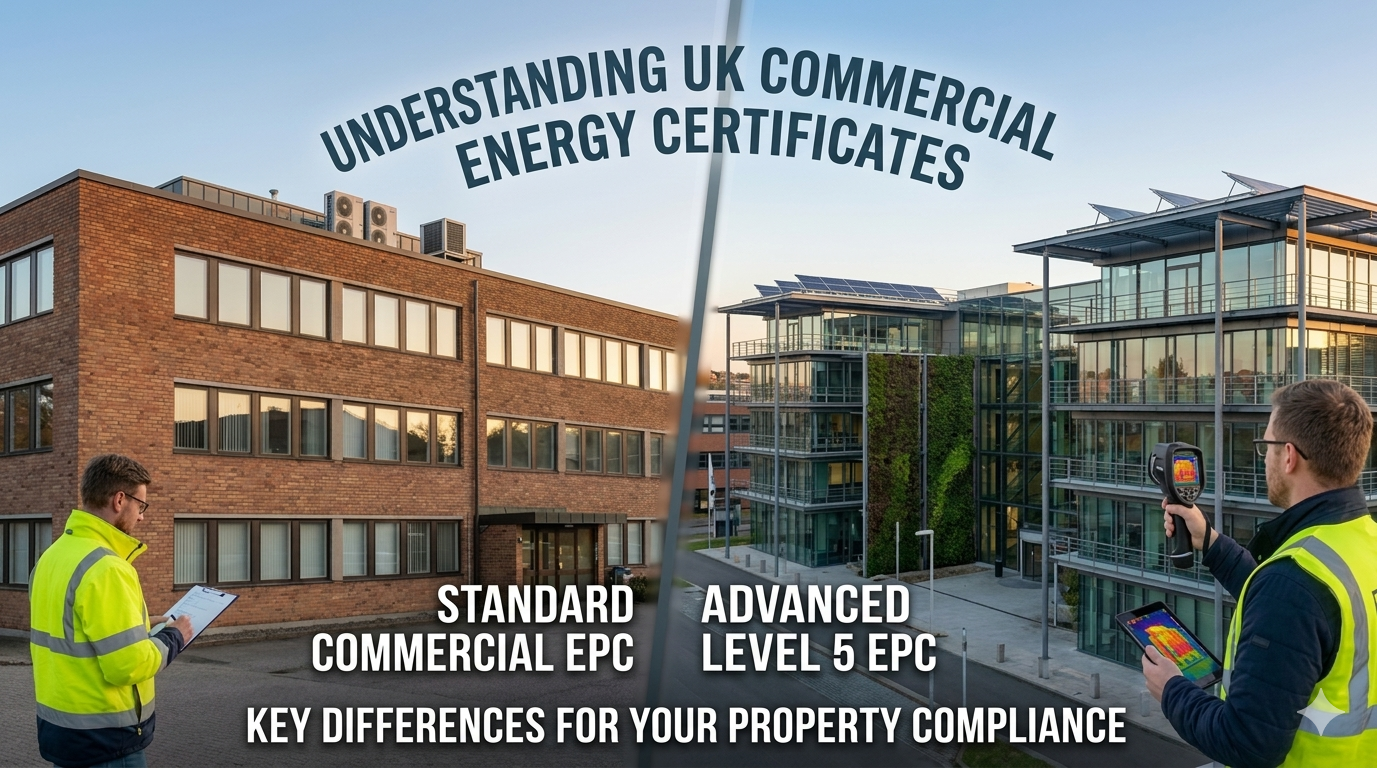
Energy efficiency has become a major priority for businesses and property owners across the UK. Rising energy costs, stricter regulations and increasing pressure to reduce carbon emissions have all made building performance a key focus for commercial property management.
If you own, lease or manage commercial property, you’ve probably encountered terms such as Commercial EPC and Level 5 EPC. At first glance, they can sound like two versions of the same certification. However, they refer to very different aspects of energy assessment.
Understanding the distinction is important for ensuring regulatory compliance, choosing the right assessor and making informed decisions about improving building efficiency.
This guide explains what each term means, how they differ and when each applies to your property.
Understanding Energy Performance Certificates in the UK
Before diving into the difference between a Commercial EPC and a Level 5 EPC, it’s helpful to understand the purpose of Energy Performance Certificates (EPCs).
An EPC measures the energy efficiency of a building and provides a rating from A to G, where:
- A represents the most energy-efficient buildings
- G represents the least energy-efficient buildings
The rating is calculated based on several factors, including:
- Heating and cooling systems
- Lighting efficiency
- Insulation levels
- Building fabric and construction
- Ventilation systems
The certificate also includes a recommendation report outlining practical ways to improve the building’s energy performance.
In the UK, EPCs are required for most buildings when they are constructed, sold or rented.
For commercial properties, the EPC falls under the Non-Domestic EPC category.
What Is a Commercial EPC?
A Commercial Energy Performance Certificate is an official document that evaluates the energy efficiency of a non-domestic building.
It applies to a wide range of commercial properties, including:
- Office buildings
- Retail stores
- Restaurants and cafés
- Warehouses
- Industrial units
- Hotels and hospitality venues
When a building is assessed, a qualified energy assessor gathers detailed information about the property. This includes the building’s size, layout, heating systems, lighting, ventilation and insulation.
Using specialized energy modelling software, the assessor calculates the building’s energy usage and carbon emissions, which determine the final EPC rating.
When Is a Commercial EPC Required?
In most cases, a commercial EPC is required when:
- A commercial property is sold
- A property is leased to new tenants
- A new building is constructed
- A property undergoes major renovations
The certificate is then lodged on the national EPC register and remains valid for 10 years, unless significant changes are made to the building.
What Is a Level 5 EPC?
A Level 5 EPC is often misunderstood because it sounds like a type of certificate. In reality, it refers to the qualification level of the energy assessor conducting the assessment.
Energy assessors in the UK must hold specific qualifications depending on the type and complexity of buildings they evaluate.
The qualification levels typically include:
- Level 3 Non-Domestic Energy Assessor – suitable for simpler commercial buildings
- Level 4 Non-Domestic Energy Assessor – suitable for slightly more complex buildings
- Level 5 Non-Domestic Energy Assessor – required for large or complex buildings
A Level 5 qualified assessor is trained to evaluate buildings that involve advanced mechanical and electrical systems or large, complicated layouts.
Why Some Buildings Require a Level 5 Assessor
Large commercial properties often contain sophisticated systems that significantly influence energy consumption.
These may include:
- Advanced HVAC (Heating, Ventilation and Air Conditioning) systems
- Building Management Systems (BMS)
- District heating or cooling systems
- Complex lighting control systems
- Large ventilation networks
Assessing the energy performance of these buildings requires a deeper level of expertise and modelling.
A Level 5 energy assessor has the training and certification needed to accurately analyse these systems and produce a compliant EPC.
Types of Buildings That Often Require Level 5 Assessments
While every property is different, the following types of buildings commonly require a Level 5 assessor:
Large Office Buildings
Corporate offices with multiple floors, centralized HVAC systems and complex layouts require detailed modelling.
Hospitals and Healthcare Facilities
Healthcare buildings operate 24/7 and use specialized equipment and ventilation systems that significantly affect energy usage.
Universities and Educational Campuses
These buildings often contain laboratories, lecture halls, offices and residential areas within the same complex.
Shopping Centres
Retail centres feature multiple tenants, shared heating systems and extensive lighting systems.
Airports and Transport Hubs
Large transport buildings require advanced climate control and ventilation systems to manage passenger flows.
These environments demand a more advanced level of technical assessment.
Commercial EPC vs Level 5 EPC: The Key Difference
Although the terms are frequently used interchangeably, they refer to completely different things.
| Aspect | Commercial EPC | Level 5 EPC |
| Meaning | Energy certificate for a commercial building | Qualification level of the assessor |
| Purpose | Shows energy efficiency rating | Allows assessment of complex buildings |
| Output | EPC rating (A–G) and improvement recommendations | Enables production of a valid EPC |
| Applies to | All commercial buildings requiring EPCs | Larger or technically complex buildings |
- A Commercial EPC is the document.
- A Level 5 EPC refers to the professional qualification needed to produce it for complex buildings.
How the EPC Assessment Process Works
Regardless of the building complexity, the EPC assessment process usually follows several steps.
1. Property Inspection
The energy assessor visits the property to collect detailed data on:
- Building dimensions
- Construction materials
- Insulation
- Heating and cooling systems
- Lighting systems
- Ventilation equipment
For large buildings, this process can take several hours or even multiple site visits.
2. Energy Modelling
The collected information is entered into government-approved energy modelling software.
This software calculates:
- Estimated energy consumption
- Carbon emissions
- Overall building efficiency
3. Generating the EPC Rating
The software produces an EPC rating between A and G.
The rating is based on the building’s theoretical energy performance, not the actual energy bills.
4. Recommendation Report
The final report includes suggestions for improving efficiency, such as:
- Installing LED lighting
- Improving insulation
- Upgrading HVAC systems
- Introducing renewable energy technologies
5. Certificate Registration
The EPC is lodged on the national EPC database and issued to the property owner.
Minimum Energy Efficiency Standards (MEES)
Energy efficiency regulations in the UK have tightened significantly in recent years through the Minimum Energy Efficiency Standards (MEES).
Under current regulations:
- Commercial properties must have a minimum EPC rating of E to be legally rented.
- Properties rated F or G cannot be leased unless an exemption is registered.
These regulations aim to improve the energy performance of the UK’s commercial building stock and reduce carbon emissions.
Future government targets are expected to push buildings toward higher minimum ratings.
Why Accurate EPC Assessments Matter
A properly conducted EPC assessment provides more than just regulatory compliance.
It can also deliver significant business benefits.
Lower Operating Costs
Energy-efficient buildings typically consume less power, reducing utility bills.
Higher Property Value
Buildings with better EPC ratings are generally more attractive to investors and tenants.
Improved Tenant Satisfaction
Comfortable indoor temperatures, better lighting and efficient systems can improve occupant experience.
Support for Sustainability Goals
Many organizations now have net-zero or carbon reduction targets, and EPC assessments help track progress.
Common Misconceptions About Level 5 EPCs
There are several misunderstandings surrounding Level 5 EPC assessments.
“Level 5 EPC means a higher energy rating”
This is incorrect. Level 5 does not affect the rating. It simply indicates the qualification level of the assessor.
“Only very large buildings need EPCs”
All commercial buildings generally require EPCs when sold or rented, regardless of size.
“EPCs reflect real energy bills”
EPC ratings are based on standardized modelling, not actual energy consumption.
How to Choose the Right Energy Assessor
Selecting the right assessor ensures your EPC is accurate and compliant.
Here are a few things to consider:
Check accreditation
Energy assessors must be registered with an approved accreditation scheme.
Confirm qualification level
Ensure the assessor holds Level 5 certification if your building is large or complex.
Look for experience with similar buildings
Assessors familiar with your building type can produce more accurate evaluations.
Ask about turnaround times
Larger buildings may require more time to assess.
The Future of Commercial Energy Assessments
Energy regulations in the UK are expected to continue evolving.
Government proposals suggest that commercial buildings may need to achieve higher EPC ratings in the coming years, potentially reaching C or better.
This means property owners will increasingly need to:
- Upgrade heating and cooling systems
- Improve insulation and building fabric
- Install energy-efficient lighting
- Consider renewable energy solutions
As regulations tighten, the role of qualified energy assessors—particularly those with Level 5 expertise—will become even more important.
Final Thoughts
Understanding the difference between a Commercial EPC and a Level 5 EPC becomes much clearer once the terminology is broken down.
A Commercial EPC is the official certificate used to measure the energy efficiency of a non-domestic building, providing a rating from A to G along with recommendations for improving performance. A Level 5 EPC, on the other hand, refers to the qualification level of the energy assessor who is trained to evaluate larger or more complex commercial properties.
For smaller commercial units, a lower-level assessor may be sufficient. However, buildings with sophisticated systems, large floor areas or complex layouts often require a Level 5 qualified professional to ensure the assessment is accurate and fully compliant with UK regulations.
As energy efficiency standards continue to evolve in the UK, having a reliable and experienced energy assessment provider becomes increasingly important. Working with professionals such as CCA Environmental Ltd can help ensure that your commercial property receives an accurate EPC assessment while identifying practical opportunities to improve energy efficiency and remain compliant with current and future regulations.
Taking a proactive approach to energy performance not only helps meet legal requirements but can also reduce operational costs, improve property value and support long-term sustainability goals.
Frequently Asked Questions
What is the difference between a Commercial EPC and a Level 5 EPC?
Ans. A Commercial EPC (Energy Performance Certificate) is a document that measures the energy efficiency of a non-domestic building and provides a rating from A to G. A Level 5 EPC does not refer to a certificate but to the qualification level of the energy assessor who is authorised to assess large or complex commercial buildings.
In simple terms, the Commercial EPC is the report, while Level 5 refers to the expertise required to produce it for certain buildings.
When is a Commercial EPC required in the UK?
Ans. A Commercial EPC is required when:
- A commercial property is sold
- A property is rented to a new tenant
- A new commercial building is constructed
- Major building renovations are completed
The certificate must be made available to prospective buyers or tenants and is typically valid for 10 years.
What buildings require a Level 5 EPC assessor?
Ans. Buildings that usually require a Level 5 qualified non-domestic energy assessor include:
- Large office buildings
- Hospitals and healthcare facilities
- Shopping centres
- Universities and large educational campuses
- Airports and transport hubs
- Complex mixed-use developments
These buildings often have sophisticated heating, cooling and ventilation systems that require advanced energy modelling.
Can any energy assessor produce a Commercial EPC?
Ans. No. Energy assessors must be properly accredited and qualified to assess specific building types.
For simpler buildings such as small offices or retail units, a Level 3 or Level 4 assessor may be sufficient. However, larger or more complex buildings require a Level 5 assessor to ensure the EPC complies with UK regulations.
How long does a Commercial EPC last?
Ans. A Commercial EPC is valid for 10 years from the date it is issued. However, if major changes are made to the building—such as installing new HVAC systems or carrying out structural renovations—it may be beneficial to obtain a new EPC to reflect the updated energy performance.
What is the minimum EPC rating for commercial properties in the UK?
Ans. Under the Minimum Energy Efficiency Standards (MEES) regulations, commercial properties must generally have a minimum EPC rating of E to be legally rented.
Buildings with F or G ratings cannot typically be leased unless the owner registers an exemption.
Future regulations may require commercial buildings to achieve higher minimum ratings, such as C or above.
Does a Level 5 EPC mean a better energy rating?
Ans. No. A Level 5 EPC does not influence the energy rating of the building.
It simply refers to the qualification level of the assessor conducting the assessment. The EPC rating itself depends on factors such as insulation, heating systems, lighting and overall building efficiency.
How much does a Commercial EPC cost?
Ans. The cost of a Commercial EPC varies depending on several factors, including:
- Building size
- Property complexity
- Location
- Type of systems installed
Small commercial units may cost £100–£300, while large or complex buildings requiring a Level 5 assessor may cost significantly more due to the detailed assessment involved.
Can improving an EPC rating increase property value?
Ans. Yes. Improving an EPC rating can make a commercial property more attractive to tenants and investors.
Energy-efficient buildings typically benefit from:
- Lower operating costs
- Higher rental demand
- Increased property value
- Better compliance with future regulations
For this reason, many property owners invest in energy upgrades after receiving EPC recommendations.